


In Part I, I told you why this series is personal for me... the tavern where George Washington said goodbye to his officers…. and the German-American oyster house in Jersey City where my immigrant great-great-grandfather built his own business and a new life. This piece is about the system both of those places belonged to. Before we can get to McDonald’s itself (and we’re getting there, with a thesis that is not really about hamburgers), we need to understand what American foodservice actually is, where it came from, and why it was always going to produce a McDonald’s. Just like America’s geopolitical assets were always going to produce a Cargill. And just how the American spirit of entrepreneurship and relentlessness was always going to produce a Walmart.
As with those previous two installments in this mega series, we’ll thread the story of a single company with the story of the industry that brought it to be. In the Walmart piece, that meant the rise of modern retailing… centralization, scale, store economics, and the strange, esoteric world of trade-promotion spending. In the Cargill piece, we had to lay down the geopolitical and agricultural realities that made a company like Cargill not just possible but inevitable. McDonald’s demands the same treatment because McDonald’s didn’t arise from nowhere. It emerged as the logical product of centuries of eating patterns, labor structures, and technological change... and then amplified those patterns, standardized them, and exported them around the world.
I call the subject of this essay “Public Food.” That is… food prepared, sold, and consumed outside the home, by someone other than you or someone in your household. And it’s actually one of the oldest institutions of civilization.
Interactive chart here: https://datahud.ai/foodaway
Bread and Circuses
For most of human history, eating outside the home was not really about leisure or convenience. It was more about hierarchy and control.
The earliest forms of organized foodservice didn’t emerge for ordinary everyday people but for elites, travelers, and the state apparatus. In ancient Mesopotamia and Egypt, public eating clustered around temples and palace complexes, where prepared food was distributed to priests, soldiers, and laborers as organized rations. Don’t think of these as restaurants. They were more like feeding systems.
It was actually the Roman world which produced the closest ancestor of the modern fast-food counter. This was the thermopolium. These small, street-facing shops were embedded into apartment blocks in dense cities like Pompeii and Herculaneum. Picture a masonry counter with large clay pots (dolia) set directly into the stone, keeping pre-cooked stews, legumes, and wine warm for walk-up customers. The people buying from them mostly lived in insulae, apartment buildings without kitchens. The thermopolium provided nourishment for people whose tight urban living conditions made home cooking impractical.
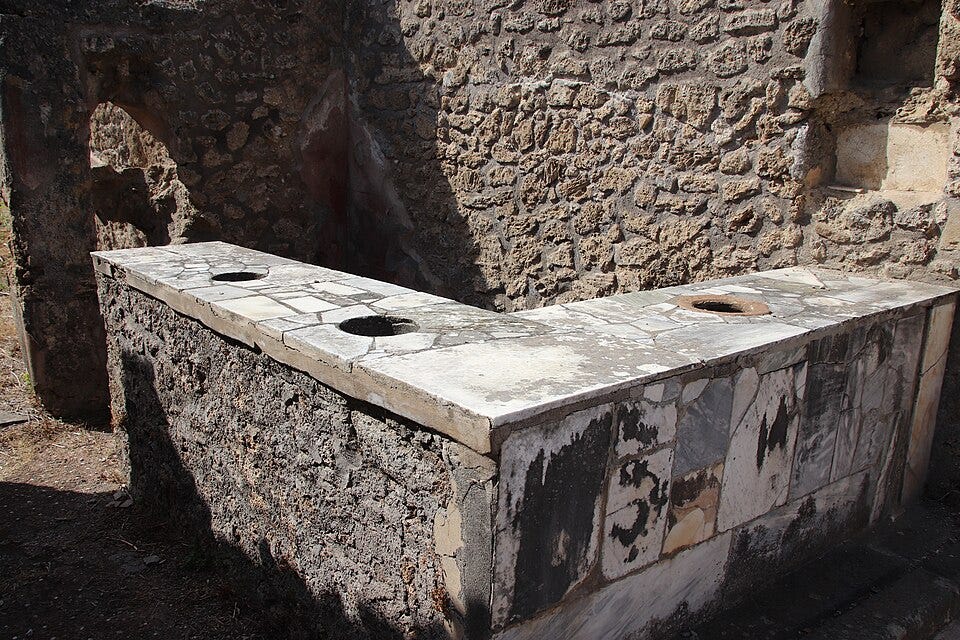
This was ~2,000 years before the drive-thru. The urban density plus kitchen-less households demanded a market for fast hot food at a counter somewhere.
Then alongside these sat the Roman popinae and cauponae. These were…
